Daily field briefing
POLR AIPOLR AI

AI + AEC Today

Daily AI intelligence for the built world

Weekly digest

Weekly AI in AEC stories

← Archive

Edition · Wednesday, November 4, 2026

AI & Construction

Weekly Pulse · Industry actionability

The field is piloting, not just experimenting.

57%
ExperimentalPilotingField-ready
  • AI agents can now run real BIM and CAD tasks, not just talk about them
  • No-code tools let field and office staff build their own AI apps
  • AI that checks drawings for errors is pulling in real money and real projects
  • Every tool still needs a person to check the work before it goes live

Practical Use of the Day

Run a quick AI check for gaps between your drawings and specs

Big AI tools now catch drawing errors. You can do a smaller version today for free. Pick one scope, like doors or plumbing fixtures. Copy the matching spec text and a short list of what the drawings show. Ask an AI chat tool to compare the two and flag anything that does not match or is missing. You get a short punch list in minutes. Then have your team check each item, since the AI can still miss or misread one. This helps you catch a bad detail before it turns into an RFI or a change order.

Try this prompt

You are helping me, a general contractor, do a first-pass coordination check. I will give you one spec section and a list of items shown on the drawings for the same scope. Compare the two. List anything that does not match, is missing from one side, or looks unclear. For each item, say where you saw the problem and why it matters. Put it in a simple table. Do not invent items that are not in what I give you. If something is unclear, ask me before you guess.

Tool — Any AI chat tool, like Claude or ChatGPT

Stories

4 curated
ConTechHigh impact

Autom8Labs gives AI agents the know-how to work inside Revit and AutoCAD

Autom8Labs put out 22 free skills for AI agents. A skill is a set of steps that teaches an AI how a pro does a task. The skills work with Revit, AutoCAD, Navisworks, Civil 3D, Rhino, and more. So the AI does not just open the tool. It knows the right way to do the job, like making families, checking model health, or setting up a render.

Why it matters to GCs

Your team loses hours on slow, repeat modeling work. An AI that knows the real steps could take some of that off their plate. The skills are free to try, and the firm can build ones that match your own templates and sign-off checks. A person still needs to check the output before it goes in a live model.

AEC Magazine·Nov 3·Read source →
LinkedIn
AI & BusinessHigh impact

Archiboost raises $6.2M for AI that catches drawing errors before the field

Archiboost makes an AI tool that reads construction drawings. It looks for errors, missing items, and parts that do not line up. It reads both PDF and Revit files. The company just raised 6.2 million dollars. It says it has checked more than 550,000 drawing sheets across 3.5 billion dollars in projects. Those are its own numbers, so check them.

Why it matters to GCs

A missed clash or a bad detail turns into an RFI, a change order, or rework in the field. Catching it in the drawings is far cheaper than fixing it on site. A tool like this could cut costly surprises. But a person still has to confirm each thing it flags.

Commercial Observer·Nov 3·Read source →

LinkedIn
ConTechModerate

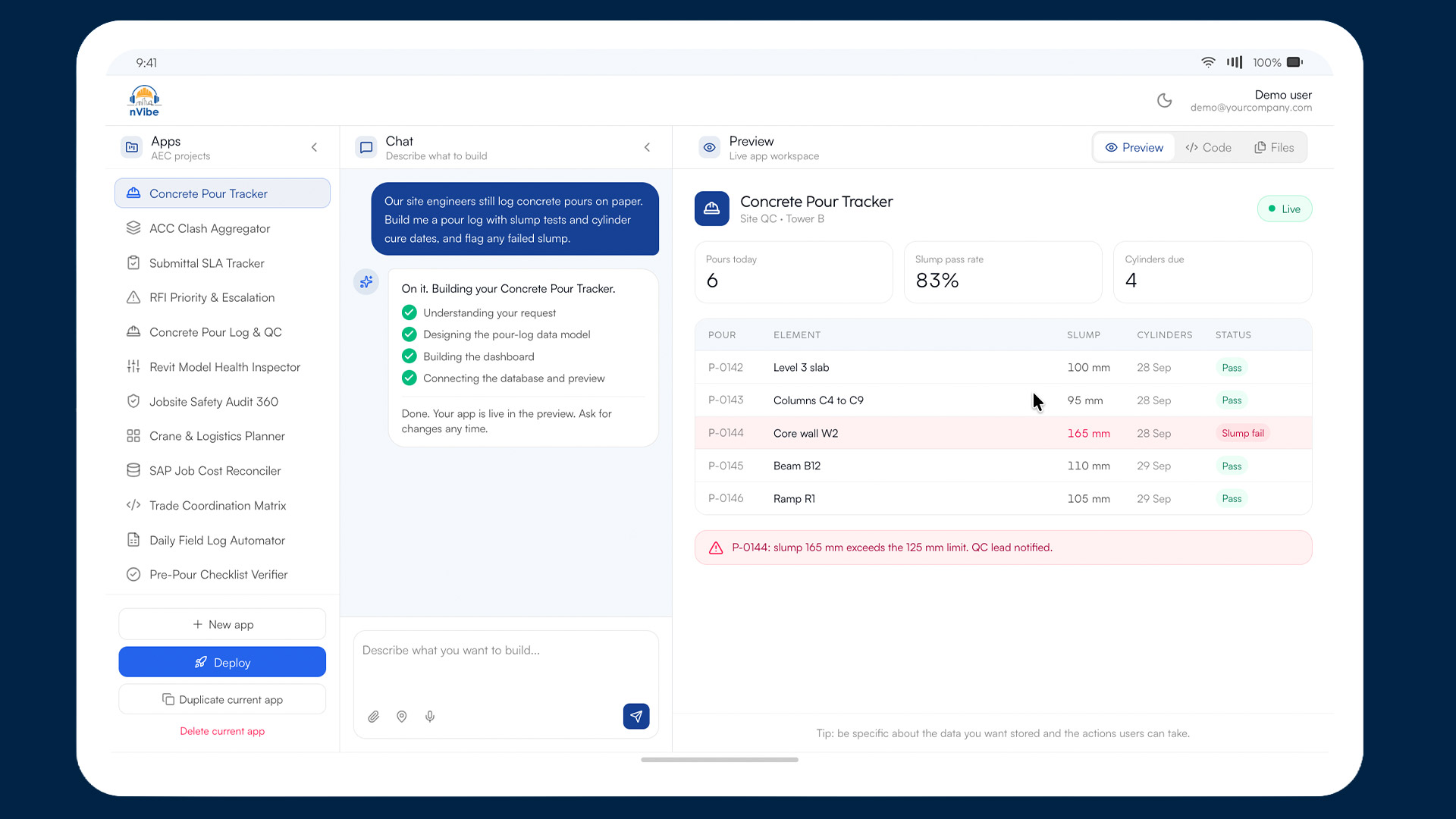
New tool lets site teams build their own apps by typing plain English

nCircle Tech launched a tool called nVibe. You describe the app you want in plain words, and the AI builds it. No coding needed. It knows construction terms like RFI, submittal, and WBS codes. A site manager could make a daily labor and safety tracker, or a clash dashboard. The apps are built in a safe space, so IT keeps control of security.

Why it matters to GCs

Custom software usually means a long wait and a big bill. This lets your own people build simple tools fast. That could cut the wait for a tracker or checklist from months to days. Keep IT in the loop so a home-made app does not turn into a hidden risk.

AEC Magazine·Nov 3·Read source →

LinkedIn
AI FrontierLow

Anthropic builds a way to prove which AI really answered you

Anthropic makes the AI tool Claude. It shared a new system called FlashProve. It can prove that an AI answer came from the exact model it claims to be. Each model gets a kind of fingerprint. Later, anyone can check an answer against it. This does not give away the model's secrets. It is early work, not a finished product.

Why it matters to GCs

You may soon trust AI for takeoffs, RFIs, or code checks. This is about knowing the answer really came from the strong model you paid for, not a weaker swap. For risky work, proof of what did the job helps with trust, and with blame if something goes wrong.

TechCrunch·Nov 3·Read source →

LinkedIn